ebblo is dedicated to shaping the future of public transport
The transport industry is changing fast. When will all buses run on renewable energy or drive autonomously? What other tasks will artificial intelligence take on for transport operators? We don’t know exactly – but we are already developing the right solutions to support public transport, now and in the future.
AI-supported operations control
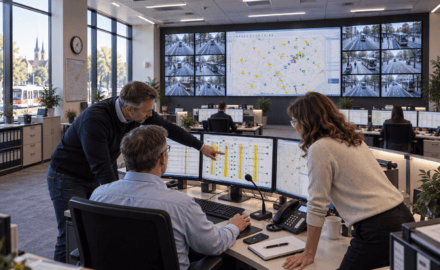
Artificial intelligence is changing life in the control centre. AI applications help ease staff workloads and improve service quality. AI-supported dispatch automation, for example, can analyse passenger flows in real time and adjust transport capacity accordingly – for higher utilisation, more reliable planning, and more stable operations.
Artificial intelligence is already used in practice today: operational data is analysed, patterns are identified, and concrete recommendations follow for the control centre and dispatch team. AI supports the optimisation of network data, for example, which forms the basis for more reliable and precise journey times and arrival forecasts in passenger information. Unusual vehicle or operational conditions are flagged early, enabling more targeted monitoring and faster repairs. At the same time, staff are relieved of workload, as operational data is brought together automatically, complex information is made easy to understand, and data is translated into operational recommendations.
Resilience and incident management
Resilience of IT systems must be a priority, given external threats such as cyberattacks or physical damage. Redundant systems increase system and data reliability, keeping operations running securely and without interruption. Software solutions that help restore operations quickly after an incident are equally important.
With ebblo’s incident management tool, we give dispatchers a comprehensive tool that does more than display operational information during an incident – it suggests the right response, intelligently and based on the situation. Predefined measures within action plans can be activated and deactivated within moments.
ISO certification: cybersecurity and data protection
Digitalisation brings growing requirements for cybersecurity and data protection in public transport. ebblo addresses these risks with structured security and risk management and holds ISO 27001 certification for information security and management systems.
We help our customers meet the requirements set out in Germany’s KRITIS regulation for critical infrastructure, and place great importance on protecting personal data in line with the GDPR. We also factor in the requirements of the Cyber Resilience Act (CRA) and the Radio Equipment Directive (RED) when developing our components.
V2X pilot phase: connecting vehicles and infrastructure
In a few years, many private and commercial vehicles will be equipped with V2X components, and city traffic lights will communicate bidirectionally via V2X. These Cooperative Intelligent Transport Systems (C-ITS) use globally standardised communication to improve safety and traffic flow.
Vehicles interacting with each other, and with infrastructure such as traffic lights, brings major benefits: energy efficiency, punctuality, schedule stability, and greater safety. To make V2X technology work well for public transport, ebblo set up a consortium of technology companies to standardise communication between public transport control systems and V2X components. Following a successful pilot in Hamburg, version 2.0 of the jointly developed PTX interface is now publicly available, enabling standardised coupling between ITCS on-board computers and C-ITS onboard units.
Flexible, interoperable, future-proof: ebblo for any IT environment
ebblo’s systems integrate flexibly into a wide range of IT environments – from cloud applications to highly secured networks. Transport operators can continue to use existing system landscapes, deploy ebblo devices, or combine components from different manufacturers. We make data from our applications available to third-party systems through open interfaces. ebblo is active in VDV standardisation committees, including work on IBIS-IP (VDV 301) and Internet-of-Mobility (VDV 435). This helps us make cross-manufacturer integration in public transport simpler in the long term.
Proven in practice: autonomous transport
Automated, connected vehicles will soon play an important role in addressing driver shortages and expanding transport services. With close to ten years of experience in automated driving, ebblo has already shown that autonomous shuttles from different manufacturers can be integrated into existing control systems – for both scheduled and demand-responsive services. Projects in Schaffhausen and Bern demonstrate that our solution is proven in practice and adapts flexibly to future requirements.
Building on this, we take part in future research and pilot projects that aim to integrate automated vehicles efficiently into existing operations and deliver the best possible user experience.
LIO-Volta: reliable electromobility
In around ten years, public transport is expected to run largely on battery and hydrogen buses. ebblo supports transport operators moving to energy-efficient vehicles with the LIO-Volta system. It offers features including consumption forecasting, range calculation, and alerts for low battery levels. This makes vehicle deployment easier to plan and helps prevent breakdowns.
Interfaces: mobility as a service (MaaS)
MaaS platforms connect public transport services with other mobility options, such as taxis, car sharing, or bike sharing. The aim is to offer a single, demand-based, intermodal journey as a sustainable alternative to private cars. These additional services strengthen public transport, increase passenger numbers and loyalty, and open up new business models. Reliable real-time data and precise forecasts from ebblo’s ITCS solution provide the perfect basis for attractive MaaS offers. Together with Mentz, we have successfully implemented a solution for publishing arrival forecasts based on VDV 454 via an MQTT broker.
ebblo Assist: accessible travel
Public transport must be simple, safe, and self-determined for everyone to use. That’s why ebblo develops inclusive solutions that consider a wide range of needs from the outset, remove barriers, make orientation easier, and help transport operators make passenger information accessible to all.
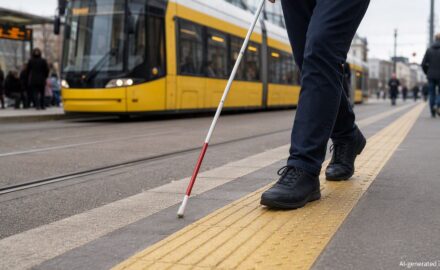
The ebblo Assist mobility assistance system helps blind and visually impaired people find the right vehicle using a Bluetooth handheld transmitter and smartphone app, makes boarding and alighting easier, guides them along their route, and provides real-time audio announcements. This gives passengers greater independence, while easing pressure on drivers. Passengers in Saarbrücken, Schaffhausen, and Berlin already benefit from ebblo Assist today.
Summary and outlook: ready for the future, together
The future of public transport will be more digital, more connected, and more demanding. ebblo is ready: with solutions proven in practice, open interfaces, and the ability to translate new technology into concrete applications early on. This helps transport operators not just manage change, but shape it actively.
How does artificial intelligence support operations control at ebblo?
AI-supported automation analyses passenger flows in real time and adjusts transport capacity accordingly – for higher utilisation, more reliable planning, and more stable operations. Operational data is analysed, patterns are identified, and concrete recommendations follow for the control centre and dispatch team, while unusual vehicle or operational conditions are flagged early.
What is ebblo’s incident management tool?
ebblo’s incident management tool gives dispatchers a comprehensive tool that does more than display operational information during an incident – it suggests the right response, intelligently and based on the situation. Predefined measures within action plans can be activated and deactivated within moments, helping restore operations quickly after an incident.
What cybersecurity certification does ebblo hold?
ebblo holds ISO 27001 certification for information security and management systems, and addresses growing cybersecurity and data protection requirements with structured security and risk management. ebblo also helps customers meet the requirements of Germany’s KRITIS regulation and the GDPR, and factors in the Cyber Resilience Act (CRA) and the Radio Equipment Directive (RED) when developing its components.
What is the PTX interface, and what is it used for?
The PTX interface enables standardised coupling between ITCS on-board computers and C-ITS onboard units, making V2X technology work well for public transport. It is the result of a consortium of technology companies initiated by ebblo, and following a successful pilot in Hamburg, is now publicly available in version 2.0 – improving safety and traffic flow.
Which cities already use ebblo Assist?
Passengers in Saarbrücken, Schaffhausen, and Berlin already benefit from ebblo Assist today. The mobility assistance system helps blind and visually impaired people find the right vehicle using a Bluetooth handheld transmitter and smartphone app, makes boarding and alighting easier, guides them along their route, and provides real-time audio announcements.