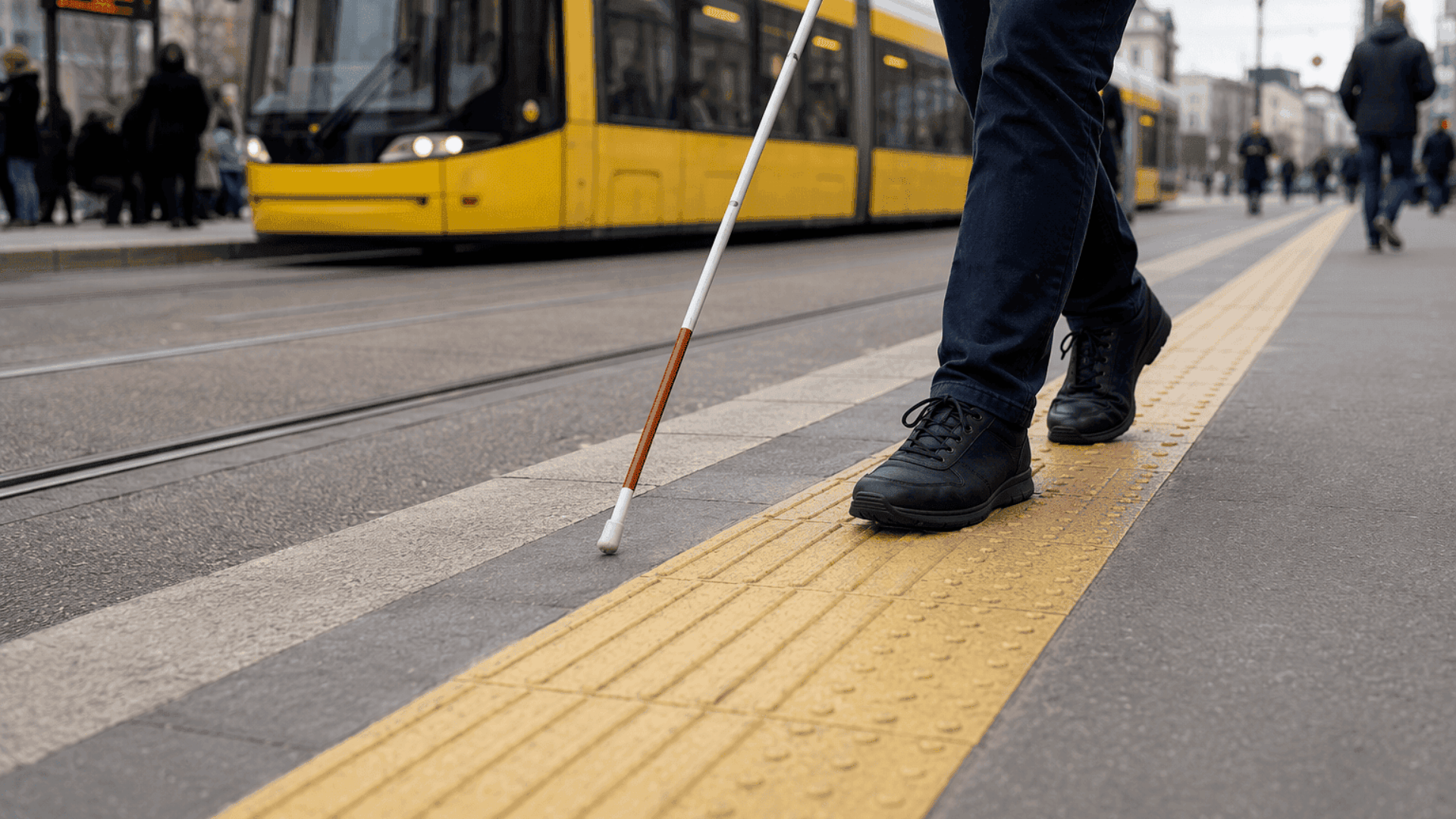
AI-generated image
White Cane Day 2026: Enabling Independent Mobility
On 15 October, this year’s International White Cane Day draws attention worldwide to the concerns of blind and visually impaired people. The white long cane is an important symbol of orientation and independence. The day focuses on independence, safety and equal participation.
For many blind and visually impaired people, the white cane is an indispensable aid – and an internationally recognised sign of protection and identification. It supports orientation and alerts other road users to a visual impairment. White Cane Day aims to raise public awareness of existing obstacles in everyday life. It calls for greater consideration – for example, by keeping tactile guidance lines, pavements and access points to public transport clear.
Actions planned worldwide
Around International White Cane Day, a wide range of activities take place in numerous countries. Associations, organisations and initiatives explain what the white cane means and highlight barriers in everyday life and in traffic. With campaigns, events and awareness activities, they promote greater consideration and equal participation.
One example is the campaign “Weisser Stock = Stopp!” (“White Cane = Stop!”) by the Schweizerischer Blinden- und Sehbehindertenverband (sbv, the Swiss Association for the Blind and Visually Impaired). It reminds people that in Switzerland, anyone who raises a white cane at the side of the road is signalling that they want to cross. All vehicles must stop and wait until the person has crossed completely – even where there is no pedestrian crossing.
Independent travel: the ebblo solution
With ebblo Assist, ebblo makes a concrete contribution to more inclusive public transport. The mobility assistance solution helps blind, visually impaired and mobility-impaired passengers use buses and trains more independently. It combines a smartphone app, vehicle hardware and a back-end system into one integrated solution. Passengers receive support with orientation, with finding the right vehicle and the right door, and with boarding and alighting. The passenger app was developed together with experts from the sbv.
Live in Berlin: ebblo Assist in practice
Visitors could see how the solution works in practice during InnoTrans 2026 in Berlin. The solution ebblo Assist was presented at the stand and also shown live in regular service of Berliner Verkehrsbetriebe (BVG) on bus route 186. As part of the project “Fahrgastinformation akustisch” (“acoustic passenger information”), it is the first bus route equipped with the solution. Up to 20 buses automatically announce their route number and destination through external loudspeakers. An acoustic door-finding signal also makes orientation easier when boarding. Together, BVG, the sbv and ebblo are sending a signal for public transport that gives everyone as independent, safe and comfortable a travel experience as possible.
When is International White Cane Day 2026, and what is it about?
International White Cane Day takes place on 15 October. It draws attention worldwide to the concerns of blind and visually impaired people. The focus is on independence, safety and equal participation. The white long cane is seen as an important symbol of orientation and independence.
What does the white cane mean for blind and visually impaired people?
For many blind and visually impaired people, the white cane is an indispensable aid. It supports orientation. It is also an internationally recognised sign of protection and identification, and it alerts other road users to a visual impairment. The day raises public awareness of existing obstacles in everyday life.
What does the sbv campaign “Weisser Stock = Stopp!” mean?
The campaign by the Schweizerischer Blinden- und Sehbehindertenverband (sbv) recalls a rule in Switzerland. Anyone who raises a white cane at the side of the road is signalling that they want to cross. All vehicles must stop and wait until the person has crossed completely – even without a pedestrian crossing.
What is ebblo Assist?
The mobility assistance solution ebblo Assist helps blind, visually impaired and mobility-impaired passengers use buses and trains more independently. It combines a smartphone app, vehicle hardware and a back-end system into one integrated solution. The passenger app was developed together with experts from the sbv. With it, ebblo makes a concrete contribution to more inclusive public transport.
What support do passengers receive with ebblo Assist?
Passengers receive support with orientation, with finding the right vehicle and the right door, and with boarding and alighting. This is made possible by the interplay of the smartphone app, vehicle hardware and back-end system. In this way, blind, visually impaired and mobility-impaired people use buses and trains more independently.
Where could visitors experience ebblo Assist live in 2026?
Visitors could experience ebblo Assist during InnoTrans 2026 in Berlin. The solution was presented at the stand and shown live in regular service of Berliner Verkehrsbetriebe (BVG) on bus route 186. This is the first bus route equipped with the solution as part of the project “Fahrgastinformation akustisch” (“acoustic passenger information”).
What does ebblo Assist do on BVG bus route 186?
Up to 20 buses automatically announce their route number and destination through external loudspeakers. An acoustic door-finding signal also makes orientation easier when boarding. Together, BVG, the sbv and ebblo are sending a signal for public transport that offers everyone an independent, safe and comfortable travel experience.
What does White Cane Day call for?
The day calls for greater consideration. Specifically, it is about keeping tactile guidance lines, pavements and access points to public transport clear. In numerous countries, associations, organisations and initiatives use campaigns, events and awareness activities to explain the meaning of the white cane and to promote consideration.