ebblo Assist: Inclusive mobility put to the test in Munich
How can blind, visually impaired and mobility-impaired people use public transport independently? Even when vehicles operate autonomously in future and there is no longer a driver on board to assist them? As part of the MINGA project in Munich, ebblo Western Europe demonstrated the benefits of our digital mobility assistance solution, ebblo Assist, at the end of October. Around 25 people with relevant accessibility needs tested the solution over two days and provided us with valuable feedback.
ebblo Assist supports accessibility and inclusion
The ebblo Assist mobility assistance system helps blind, visually impaired and mobility-impaired passengers use public transport independently. Developed jointly with the Swiss Federation of the Blind and Visually Impaired (sbv), the solution connects a smartphone app with vehicle hardware and a backend system. Passengers can, among other things, trigger route announcements and door-finding signals and communicate requests to board and alight. Thanks to open interfaces, ebblo Assist can also be integrated into vehicle and system environments from other manufacturers. A handheld transmitter is also available for people who do not want to or cannot use a smartphone.
MINGA research project
The MINGA research project addresses the future of autonomous driving in local public transport in Germany. Together with 16 partners from public administration, research and industry, it is examining how autonomous mobility can be integrated safely and effectively into local public transport. The project runs until mid-2027 and is funded with around EUR 13 million by the Federal Ministry of Transport under the funding guideline “Autonomous and connected driving in public transport”.
The project focuses on testing automated and connected mobility solutions and integrating them into the existing transport system. An important aspect is how digitalisation can contribute to greater accessibility and inclusion. Within this framework, we were able to present ebblo Assist in a proof of concept (PoC) and give participants the opportunity to test it extensively.
Project partners and participants
We would like to thank all the organisations involved in the PoC for their collaboration. These are:
- Landeshauptstadt München
- Münchner Verkehrs- und Tarifverbund (MVV)
- Landkreis München
- Technische Universität München – Lehrstuhl für Verkehrstechnik
- Benz + Walter, responsible for conducting and supporting the accessibility studies and surveying the participants
- Watzinger, which provided the test bus
- Swiss Federation of the Blind and Visually Impaired (sbv)
- IABG, operator of the “Mobility Innovation Campus (MIC)” test site
We would also like to extend our special thanks to everyone who tested ebblo Assist and shared their experiences with us.
Practical testing with people who have accessibility needs
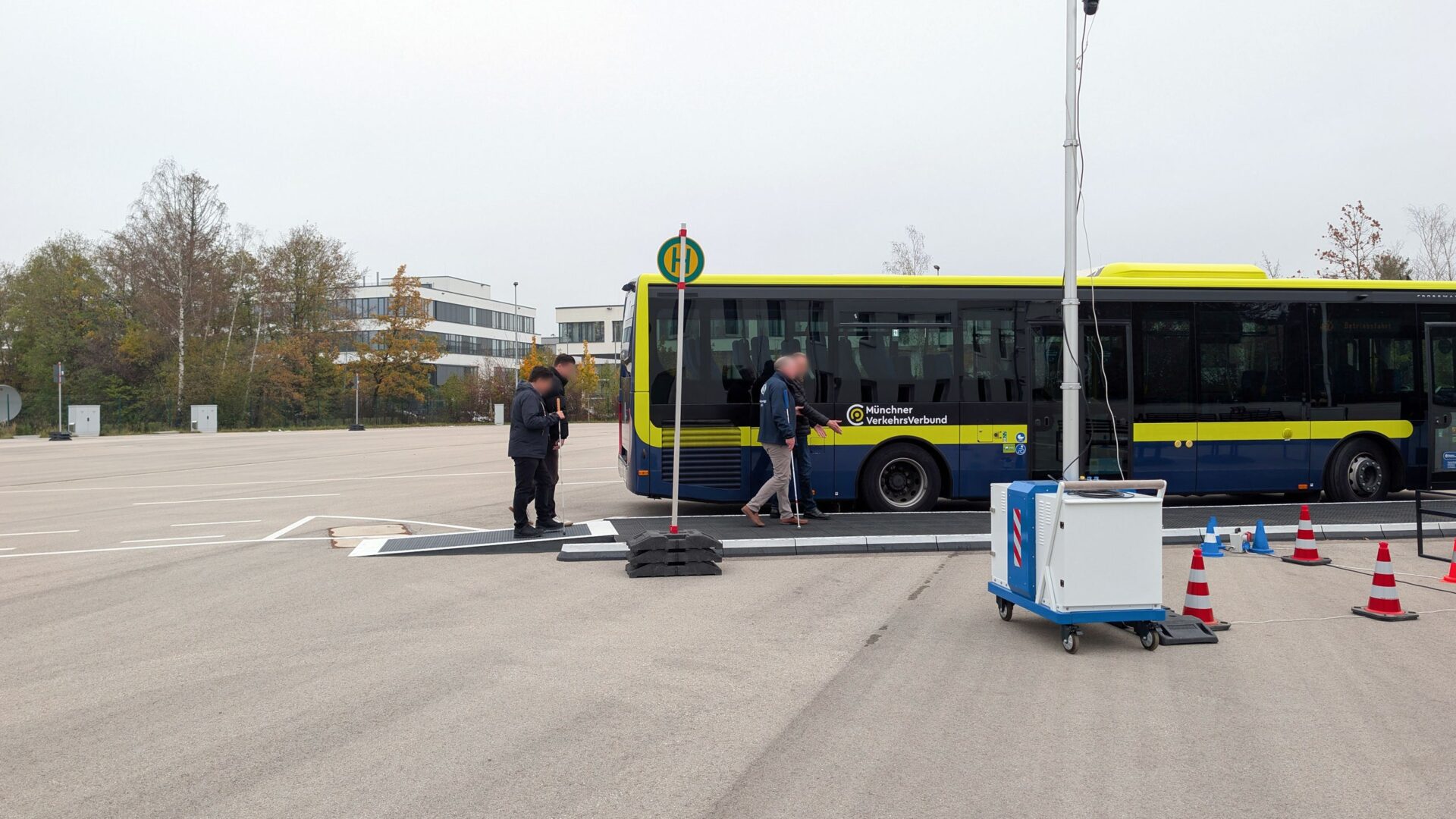
For the test, we installed ebblo Assist in a bus operated by Watzinger. On a predefined route, all participants were able to try out the functions themselves and share their previous experiences of using local public transport. A total of seven test rides took place over two days.
The focus was on direct dialogue: What support helps in everyday travel? How do users experience the operation? Where might there still be room for improvement? Feedback from people who rely on accessible services provides us with valuable input for the needs-based further development of our solution.
Positive feedback
With support from the sbv, we successfully demonstrated ebblo Assist on the designated route. According to Christoph Wehrli, Senior Business Development Manager at ebblo Western Europe, the very positive feedback from participants highlights “the potential of digital assistance systems to make public transport more accessible, more independent and more inclusive”.
At the same time, the PoC provided specific technical and functional findings that will feed into the further development and optimisation of the solution. The next step will be a joint evaluation with MVV, Benz + Walter and the Technical University of Munich.
Get to know ebblo Assist!
Would you like to experience how ebblo Assist can support your passengers? Interested transport operators are welcome to book a proof of concept with us, including as a compact one-day appointment.
Get to know the solution in practical operation and gain your own insights for your organisation. Contact us without obligation by email at [email protected]. We look forward to hearing from you and will work with you to agree the right framework for your practical trial.
What is ebblo Assist?
ebblo Assist is a mobility assistance system for blind, visually impaired and mobility-impaired passengers. It connects a smartphone app with vehicle hardware and a backend system.
What functions does ebblo Assist offer?
Passengers can, among other things, trigger route announcements and door-finding signals and communicate requests to board and alight. A handheld transmitter is available as an alternative to the smartphone app.
How does ebblo Assist support accessibility in public transport?
The solution helps passengers use public transport independently and, thanks to open interfaces, can be integrated into vehicle and system environments from other manufacturers.
What was tested during the proof of concept in Munich?
Around 25 people with relevant accessibility needs tested ebblo Assist in a bus on a predefined route. A total of seven test rides took place over two days.
What is the MINGA research project?
Together with 16 partners, MINGA is examining how autonomous mobility can be integrated safely and effectively into local public transport. The project runs until mid-2027.
Who developed ebblo Assist?
ebblo Assist was developed jointly with the Swiss Federation of the Blind and Visually Impaired (sbv).
How can transport operators get to know ebblo Assist?
Interested transport operators can book a proof of concept, including as a compact one-day appointment, and contact [email protected] without obligation.